




The Author Perspective
Sarah Leedberg did not start in higher education. Her early work took place during the 2008 financial crisis, inside institutions forced to respond as conditions shifted in real time.
Later, at Shell, she worked through an energy downturn that exposed how large systems delay decisions until pressure forces action. Those experiences shaped how she reads organizations that assume they still have time. She earned a Doctor of Education and a Master of Science in Strategic Foresight from the University of Houston, focusing on how institutions interpret uncertainty and act within it.
She now works in higher education, leading initiatives focused on innovation and execution. That position places her within the system she examines. Her approach draws on the Houston Framework Foresight, separating what can be anticipated from what cannot. Her focus remains direct. Systems do not fail from a lack of information. They fail when the response comes too late.
It moves forward. That’s the point.
Sarah Leedberg writes in a direct register that tracks how decisions form inside institutions. It follows events as they unfold, staying on sequence and outcome rather than commentary or explanation.
Unfinished Business
Decisions Don’t Wait
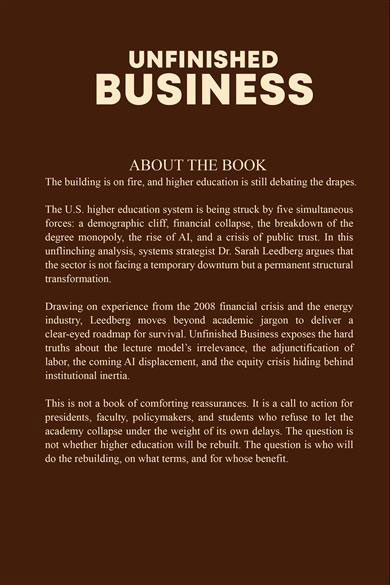
What happens when institutions keep planning for a future that is already shifting under them? Higher education is entering a phase in which demographic decline, uneven regional pressures, and changing enrollment behavior are beginning to collide. The issue is not sudden collapse, but slow misalignment that compounds over time across programs, funding, and institutional capacity. Unfinished Business breaks down how those forces interact and where they are already visible in practice. It is built for university leaders, policymakers, faculty, and planners who are responsible for decisions that cannot be postponed without consequence.
Unfinished Business
Unfinished Business: Higher Education, Artificial Intelligence, and the Decisions That Cannot Wait presents a structured analysis of a sector in the midst of permanent change. It identifies five concurrent pressures that are reshaping how institutions operate, compete, and define value. The book examines program structure, credential clarity, and the shifting role of faculty within an AI-mediated environment. It also addresses the broader economic impact of institutional stability, particularly in regions where universities serve as primary anchors. The focus remains on decision-making under constraint. The work outlines what institutions are avoiding, where alignment is required, and how leadership must respond within narrowing timelines.
Priority Response
For speaking engagements, institutional discussions, or academic collaboration, reach out directly. Inquiries related to the book or ongoing work are given priority and responded to promptly.
Explore Your Framework
The Five Forces Reshaping Higher Education: A Foresight Primer
-
By
admin
- 0 comments
An explainer on the demographic, financial, competitive, technological, and attitudinal forces driving structural change. Readers learn to distinguish temporary disruptions from permanent shifts using a foresight lens.

Why the Lecture Model Is Failing AI-Mediated Learners
-
By
admin
- 0 comments
Explores how generative AI makes passive information delivery obsolete. Discusses evidence-based alternatives that re-center faculty as high-value mentors rather than content distributors, without prescribing specific tools.

Credential Illegibility: What Skills-Based Hiring Means for Universities
-
By
admin
- 0 comments
Breaks down why traditional degrees are becoming “illegible” to employers and how skills-based hiring changes the value proposition. Offers a framework for making credentials more verifiable and portable.

In Their Words
Leedberg writes with unusual clarity, linking institutional behavior to real operational constraints without overstating outcomes or relying on abstract academic language.

Her work stays grounded in how teaching systems actually function under pressure, with a focus on what can realistically be delegated versus what cannot.

I like how the author consistently highlights regional and structural imbalance in higher education without exaggeration, keeping attention on measurable shifts rather than speculation.